Empowered by #MeToo, Gingras, Thomsen & Wachs client files lawsuit after sexual assault in Kenosha County jail. This story is featured in the Milwaukee Journal Sentinel by reporter, Gina Barton.

For every sexual abuse and assault case that makes headlines, there are many more cases of sexual assault and rape survivors who have suffered quietly and never make the headlines. Our criminal justice system can punish perpetrators, and the civil justice system can hold negligent parties accountable and provide help for victims who are unavailable in the criminal courts.

Gingras, Thomsen & Wachs, LLP can help victims take a stand and take back their lives through the civil system. Please contact us if you need our help.

With the Super Bowl just days away, football has been on almost everyone’s mind.  Recently, one cannot think of football without thinking about one thing: concussions.  Concussions have been a hot topic the past few years due to the discovery of the neurodegenerative disorder known as Chronic Traumatic Encephalopathy (CTE).  Recently, however, it has been scientifically proven that repetitive hits to the head, without ever sustaining a concussion, can also cause CTE.  This finding is critical for understanding post-injury recovery and treatment.

Alarmingly, CTE does not just affect athletes, it can affect you if you have been involved in a motor vehicle accident, are a victim of assault, or otherwise sustained multiple head injuries—even if you never sustained a concussion.  Thus, although you may have never been diagnosed with a concussion or a traumatic brain injury, your actual injury may be just as dire with the development of CTE which can produce severe permanent consequences including paranoia, depression, dementia, aggression, and suicidal tendencies.  This new scientific proof, set forth in the article Cindy Boren, A New Study Shows that Hits to the Head, Not Concussions, Cause CTE, Wash. Post (Jan. 18, 2018), may be critical to your claim for damages in your personal injury case—even if you have never been diagnosed with a concussion.


Attorney Mark Thomsen writes the cover story for the Fall, 2017 issue of The Verdict.

Underinsured Motorist ClaimThe Verdict: Motorist Claims, Breach of contract, and Entitlement of Interests:
Tales From The Trenches – Demarcating The Lines for Breach of Contract, Entitlement of Interest pursuant to Wis. Stat. § 628.46 for Delay In Paying UIM benefts, and Bad Faith

By Attorney Mark Thomsen

If your experience in obtaining underinsured motorist (UIM) benefits for your clients is at all like mine, I will assume that rarely, if ever these days, will the UIM insurer pay any UIM benefits unless your client agrees to settle all her claims. For that matter, the same can be said for uninsured motorist (UM) claims. While I have had Secura and American Family make good faith advance payments to clients in recent years, these cases are the rare exception.  Instead, adjusters routinely express their belief that the injuries did not result from the collision, or that negligence is in dispute or that causation is debatable and then insist on a complete settlement but advance no payment until the jury determines the value. This article is written in an attempt to debunk the adjusters’ posturing, provide suggestions for successfully pursuing UIM claims and hopefully contribute to the debate as to how best to prosecute UIM claims for our clients.

Purpose of UIM

It is now well established that our Supreme Court “has stated on multiple occasions that the underlying purpose of UIM coverage is to compensate the victim of an underinsured motorist’s negligence where the third party’s liability limits are not adequate to fully compensate the victim for his or her injuries.”1  “When purchasing UIM coverage, we believe that a reasonable insured expects to be protected against a loss caused by another that is not covered by the underinsured d¬-river’s liability coverage.”§2  “Underinsured motorist coverage is not purchased to obtain commercial advantage but is instead obtained as protection against calamity. 3  “Underinsured motorist coverage is first-party insurance.4 Nearly forty years ago, a Maryland court summarized the essence of a claim for breach of contract of first party insurance as follows:

A suit based upon the insured’s allegations that he is entitled to payment under one of the first party coverage clauses in the contract he entered into with his insurance carrier, and that the carrier has refused payment thereby breaching its promise, is clearly a contract action.5

Succinctly stated – “a breach of contract occurs when the insurer denies underinsured motorist benefits requested from an insured.6    As a State Farm adjuster told me in her deposition – “Our duty to our insured’s is to pay what we owe for damages incurred based upon the contract within the coverages that they purchased.7 So why when we submit substantiated claims do insurers refuse to pay what they owe and insist they have a right to a jury determination of value. My clients, insureds, thought they bought protection not lawsuits. Wisconsin law requires the UIM carrier to pay UIM claims when properly supported and no such payment is conditioned on settlement of the whole claim or having the claim reduced to judgment or arbitration award. At most, the UIM insurer is entitled to only the 30 day safe haven provision of Wis. Stat. § 628.46.

Determining Breach of Contract

“With first-party insurance, the insurer establishes ‘the conditions for both the presentment and payment of claims…. The insurer has what the Arizona Supreme Court has characterized as ‘an almost adjudicatory responsibility.’ ‘The insurer evaluates the claim, determines whether it falls within the coverage provided, assesses its monetary value, decides on its validity and passes upon payment.8  Significantly, however, a UIM claim does not exist until the underlying liability limits are exhausted.9 The UIM insurer must be notified of the liability limits tender and must consent to the settlement or substitute its funds for both a settlement with the liability carrier and the tortfeaser within 30 days of the respective offers, if different.10 Our clients are likely contractually obligated to cooperate with the UIM carrier, including during the 30 day evaluation period, and may undergo a defense medical examination.11 An insurer’s failure to timely obtain a defense medical exam to dispute an insured’s UIM claim of injury could actually establish bad faith.12

Once the liability carrier tenders and exhausts its coverage and your client submits a UIM claim supported by evidence, the UIM insurer must pay what it determines it owes and cannot insist on waiting for a jury or arbitrators to determine the value.13

Insurers provide extensive training to its adjusters and supervisors regarding, among many others, its claims procedure, generally contained in its claims manual, basic medical management training, soft tissue injury training, knee or shoulder injuries training, pain management, business practices of setting reserves, log entries, including referencing when the insurer knows it owes UIM benefits, business practices of entries into the claim file, policies regarding use of defense exams, settlement value ranges, and offers.14  As Courts have held, even “[m]uch of the information in defendant’s claim file likely will be discoverable in connection with the coverage question [or in other words breach of contract] in the first instance.”15

Insurers utilize their extensive business training and claims process to determine whether it owes our clients UIM benefits. If a UIM insurer refuses to pay any UIM benefits, utilize Wisconsin Administrative Code Ins. 6.11(5) to require the insurer “to promptly provide a reasonable explanation of the basis in the policy contract or applicable law for denial of a claim or for the offer of a compromise settlement.” You should also always particularize your claim pursuant to Wis. Stat. § 628.46 and submit proof of each element of your claim. Follow up with detailed letters to the adjuster requesting prompt, i.e. 10 day responses, as to why the insurer is not responsible for the amount demanded or “any partial amount supported by written notice.” Your submissions and follow up letters will create the necessary evidence to establish breach of contract, liability for the interest remedy under § 628.46 and bad faith. Even if your efforts are fruitful and your client settles, your client’s UIM settlement will be maximized.

Breach, Delay and/or Bad Faith

An overview of applicable case law teaches us that the UIM carrier must pay our client when it determines it owes its insured UIM benefits and is in breach if it fails to pay. We also know that every failure to pay (or breach of contract) does give rise to a claim for § 628.46 interest but not necessarily bad faith. Brethorst16, although only a bad faith claim was alleged, teaches us that when our client submits medical bills, together with medical records or reports establishing that the collision was a cause of injuries thus tying the bills to the collision, such proof is likely sufficient to establish breach. Moreover, the UIM insurer’s “belief that [our client’s] injury did not result from the accident is speculation… and provide[s] nothing to justify its failure to pay…17 Danner, as noted above, implicitly holds that an insurer cannot force an arbitration to avoid paying earlier. Moreover, Danner rejected the Arizona Court of Appeals conclusion in Voland that “a personal injury claim is unique… the ‘pain and suffering’… elements…are inherently flexible… and [o]ftentimes no more precise or predictable than throwing darts at a board.” Voland itself actually involved a UIM case where the “plaintiff never requested, let alone demanded, the carriers to pay her special damages before arbitration,” and the Court noted that “UM carriers do not need” to make gratuitous advance payments which the insured does not request.18 Voland strongly suggests its outcome would have been different had plaintiff’s counsel submitted proof and requested payment and such a ruling is consistent with Danner and Brethorst.

§ 628.46 itself implies that a breach of contract, i.e. an obligation to pay, triggers the insurers duty to pay within 30 days or pay interest for any subsequent delay. The Wisconsin Supreme Court held that Wis. Stat. § 628.46 “is an additional provision of the insurance contract incorporated into it by operation of law.”19 In Poling, the Court stated:

We see nothing in the statute, or in the obvious policy behind it, which conditions its application on the reasons why an insurerdenies or delays payment of a claim. The only escape clause for avoidance of this interest assessment is when the insurer has reasonable proof that it is not responsible for the payment. This statute is unrelated to the tort of bad faith and permits the imposition of interest even where bad faith is not present.20

In Fritsche v. Ford Motor Credit Co., the Court held the statute expressly applicable to claims for uninsured motorist benefits, first-party insurance benefits like UIM, holding:

Indeed, were we to conclude that only claims reduced to judgment or those which were the subject of an arbitration award were within the reach of § 628.46, we would effectively repeal the statute. A claim is statutorily deemed overdue if not paid within thirty days after a proof of loss or equivalent evidence of the loss…. That time can be far in advance of a judgement or award.21

The Fritsche court returned the case to the trial court for further review, but concluded stating: “It may be that the risk of mis-evaluation outweighs the risk of paying § 628.46, Stats., interest, but Rural has had the use of $25,000 which became owing to the Fritches as a result of an accident which occurred October 11, 1985. Presumably, Rural has received a return on that amount since then. We see nothing illogical in interpreting a broad statute to require Rural to pay for the use of $25,000 from the date by which it had received evidence of the loss equivalent to a proof of loss.”22

Accordingly, once a UIM claimant submits her proof of entitlement to UIM benefits, the UIM carrier must not only pay UIM benefits but also pay interest after 30 days absent a showing of “reasonable proof to establish that the insurer is not responsible for the payment.” A UIM adjuster claiming the case involves nebulous damages is not a defense.23

The standard for proving bad faith is higher than mere proof of breach and untimely payment of a claim. Our Supreme Court is clear that “[b] ad faith is not the same as breach of contract, which is a ‘failure to pay the claim in accordance with the policy.’… Rather, bad faith “is a separate intentional wrong, which results from a breach of duty imposed as a consequence of the relationship established by contract.24 “Thus to bring a bad faith claim, ‘a plaintiff must show the absence of a reasonable basis for denying benefits of the policy and the defendant’s knowledge or reckless disregard of the lack of a reasonable basis for denying the claim.25 Brethorst noted that in Danner, a UIM breach of contract and bad faith claim, the court “reiterated the principle that every insurance contract has an implied duty of good faith and fair dealing between the insurer and insured. Although the insurance contract in Danner gave both the insurer and the insured the right to seek arbitration in disagreements about the presence or amount of coverage,… the existence of that right did not relieve the insurer of its duty to act in good faith from the inception of the contract…. When the duty of good faith is breached by the insurer and that breach results in damages, an insured has a cause of action for bad faith.”26

Importantly, “[t]he purpose behind providing a bad faith cause of action to an insured is to ‘protect against the risk that an insurance company may place its own interests above those of the insured and that the recovery available to the insured for breach of contract would not fully compensate the insured for the resulting harms.”27  It is worth noting that in Danner, a bad faith claim with a higher and different standard then breach of contract or for a § 628.46 interest claim, the Court virtually summarily dismissed the insurer’s claims that because liability “rested on credibility determinations”, and given the fact the insurer’s agents themselves had concluded that the claimant’s negligence was less than the underinsured driver’s, that negligence was not fairly debatable. Similarly, given the medical and expert testimony regarding causation, the Court determined that causation was not fairly debatable and upheld the bad faith claims.28  If such arguments fail to meet the higher standard for bad faith then any such defense arguments should be irrelevant to the determination of whether the UIM carrier actually breached when it failed to pay or is liable for interest for delaying payment, i.e. such arguments should not be considered reasonable proof that the insurer is not responsible. If the testimony from the UIM adjusters and evidence in their claim file show that the insurer decided it owed some UIM benefits, the only issue really remaining is whether the failure to timely pay was in bad faith.

Confusion over scope of Dahmen’s bifurcation and stay of discovery in Cases involving both breach and bad faith

Dahmen229  involved a breach of UIM contract claim and bad faith in which the court essentially summarily ruled, with very little factual background and/or discussion, that because “the Dahmen’s claim for UIM coverage will turn on the amount of their damages,” while their bad faith claim “will examine American Family’s handling of the Dahmen’s UIM claim,” bifurcation was to be presumed. In Dahmen, all we know is that the UIM insurer claimed the value was less than the tendered liability limits leading the Court to conclude the “underlying claim relates to damages only.” But what do we do under circumstances where the insurer concluded it owed UIM but maybe not as much as claimed and yet refused to pay anything? There is much information in a claims file or obtained through the testimony of adjusters that is relevant to whether an insurer breached and when. What if some of the factual evidence of breach looked like the evidence in Danner, e.g. insurance adjusters and employees confirmed liability, but for the purpose of the litigation, the insurer concealed all such information arguing the insured was made whole by the underlying limits? The Court in Brethorst focused on the concern that bifurcation may be necessary in some cases to protect attorney client and work product, but what if the facts otherwise available already establish some wrongfully denied benefits, why should bifurcation be required? We need to submit sufficient proof to our judges to convince them to distinguish the UIM insurers superficial reliance on Dahmen and Brethorst for arguing for bifurcation and stays of discovery.30

Defense Trial Tactics

You should also anticipate that defense counsel will attempt to preclude the jury from hearing about our client’s breach of contract claim, i.e. the real nature of the case. Expect counsel to move in limine and argue that Wis. Stat. § 904.11, Wis. JI-Civil 125, or City of West Allis v. Wisconsin Elec. Power Co., 2001 WI app 226, 248 Wis. 2d. 10, 635 N.W. 2d 873, require the court to limit the jurors’ knowledge of your UIM or UM claim. However, UIM and UM cases involve first-party coverage not “liability insurance.” While not yet addressed in a published Wisconsin case, courts in other states have rejected similar arguments made by first-party insurers and hold that it was improper to “maintain the legal fiction” of permittinga UIM insurer to contend that the action was something other than a claim for benefits under its insurance policy.31 As such, your jury will hear evidence of what the insurers already paid to determine whether the defendant breached its contract with the plaintiff by not paying more.

Conclusion

I hope this overview provides a functional frame work for the evaluation of UIM claims and when such claims are entitled to interest and when bad faith is involved. Too often our Judges evaluate these contract claims identically to third-party liability claims. I believe in part, this is because we do not take the time necessary to educate our courts as to the contractual nature of these claims. I look forward to our ongoing discussion. Our clients deserve the first party benefits they purchase.

ENDNOTES

  1. Mattheisen v. Continental Casualty Co., 193 Wis.2d 192, 204, 532 N.W. 2d 729 (1995); 193; Wood v American Family Mutual Ins., 148 Wis. 2d 639, 436 N.W. 2d 594 (1989); Kaun v. Industrial Fine & Casualty Ins. Co., 148 Wis. 2d 662, 436 N.W. 2d 321 (1989); State Farm Mutual Automobile Ins. Co. v. Gillette, 251 Wis. 2d 561, 2002 WI 31 ¶ 45 fn 30, 641 N.W. 2d 662
  2. Matthiesen, 193 Wis. 2d 204. However, the Court has recognized that the legislature too sets public policy in this regard and has more recently deferred to the legislature’s more narrow view. See e.g. Gillette, 2002 WI 31 ¶ 44 (comparing UIM limits to liability limits to define UIM coverage). However, regardless of the definition, UIM claims are contract claims, not tort claims, or a hybrid claim. See Danner v. Auto-Owners Ins., 245 Wis. 2d 49, 2001 WI 90 ¶¶ 56, 57, 69, 629 N.W. 2d 159
  3. Danner, 2001 WI 90 ¶ 51
  4. Id. ¶ 49; Anderson v. MSI Preferred Ins. Co., 281 Wis. 2d 66, 91 (2005) (“a UIM claim is a first party contract claim.”); Gillette, 251 Wis. 2d @ 577.
  5. Reese v. State Farm Mut. Auto. Ins. Co., 403 A. 2d 1229, 1231-32 (Md. Ct. App. 1979).
  6. Yocherer v. Farmers Ins. Exchange, 252 Wis. 2d 114, 119-120, 643 N.W. 2d 457, 2002 WI 41 ¶ 8
  7. Deposition of Raelynn M. Kahle January 3, 2017 p.14 in Baires v. State Farm, Case No. 16-CV-402-JPSEastern District of Wisconsin.
  8. Danner, 2001 WI 90 ¶ 52.
  9. Danbeck v. American Family Mutual Ins. Co., 245 Wis 2d 186, 629 N.W. 2d 150, 2001 WI 91 ¶¶ 22-25. See also Welin v. American Family Mutual Ins. Co.,2006 WI 81¶ …. (holding where multiple claimants exist and given pro-rata exhaustion of UIM aggregate limits constitutes exhaustion and triggers UIM coverage).
  10. Vogt v. Schroeder, 129 Wis. 2d 3, 383 N.W. 2d 876 (1986); Pitts v. Revocable Trust of Dorothy Knnueppel, 2005 WI 95. UIM insurer attempting to convince a liability carrier not to pay its limits so as to not trigger any duty of the UIM carrier to pay UIM benefits is evidence of bad faith. See e.g. Danner, 2001 WI 90 ¶ 52. Given applicable Wisconsin law, a UIM carrier is not properly joined in an action with the underinsured tortfeaser or its liability carrier. In any event, why would plaintiff’s counsel give the underinsured tortfeaser the benefit of a defendant UIM insurer in the same case with yet more defense lawyers and experts building a case against your client? However keep in mind Shugarts v. Allstate Property and Cas. Ins. Co., 2017 WI App 7 (Petition for Review granted) until it is reversed (it should be because it is inconsistent with Danbeck and Vogt).
  11. Pitts, 2005 WI 95 ¶ 44.
  12. Gentry v. State Farm Mut. Auto. Ins. Co., 726 F. Sup. 2d 1160 (E.D. Cal. 2010).
  13. Danner, 2001 WI 90 ¶ 54-58 (rejecting the notion that a UIM insurer can force arbitration before paying UIM benefits); Brethorst v. Allstate Property and Casualty Ins. Co., 798 N.W. 2d 407, 2011 WI 41 ¶¶ 82-85 (failure to pay undisputed damages, e.g. medical bills, constitutes proof of breach of contract and satisfies the burden to proceed with discovery on bad faith claim).
  14. See endnote #7, i.e. Ms. Kahle’s deposition testimony describes the business practice of the presentment and payment of claims.
  15. Trinity Homes LLC v. Regent Ins. Co., 2006 WL 753125 at 2 (S.D. Ind. 2006); McLaughlin v. State Farm Mut. Auto. Ins. Co., 30 F. 3d 861, 871 (7th Cir. 1994); Williams v. Progressive Northern Ins. Co., 2007 WL 2176561 at 1 (S.D. Ind. 2007).
  16. Brethorst v. Allstate Property and Casualty Ins. Co., 798 N.W. 2d 467, 2011 WI 41 ¶¶ 83-85.
  17. Id.
  18. Voland v. Farmers Ins. Co. of Arizona, 189 Ariz. 448, 943 P. 2d 808 (1997).
  19. Poling v. Wisconsin Physicians Service, 120 Wis. 2d 603, 613, 357 N.W. 2d 293 (Ct. App. 1984).
  20. Id. (emphasis added.
  21. 171 Wis. 2d 280, 305, 491 N.W. 2d 119 (Ct. App. 1992)(emphasis added).
  22. Id at 307. Note that Kontowicz v. American Standard Ins. Co. of Wisconsin, 2006, 714 N.W. 2d, and Dilger v. Metropolitan Property and Casualty ins. Co., 2015 WI App. 54, involve third-party insurance cases and are not directly on point given UIM is first party insurance. The third party case involves the insurers “takeover of the insured’s defense and “creates a quasi-fiduciary relationship. That relationship is different from the insurer-insured relationship in a first-party claim. In a first-party bad faith claim, the insured insists that the insurer wrongfully denied benefits or intentionally mishandled a legitimate claim for benefits.” Brethorst, 2011 WI 41 ¶ 48; Casper v. Am. Int’l South Ins. Co., 2017 WI App 36, ¶¶ 16-18; Miller v. Safeco Ins. Co. of Am., 761 F. Supp. 2d 813 fn 5 (“Kontowicz, however, was a case involving a third-party claim. This is a…first-party claim…).
  23. Fritsche, at 307.
  24. Brethorst, 2011 WI 41 ¶ 25 (citing Anderson v.Continental Ins. Co., 85 Wis. 2d 368 (1978)).
  25. Id at ¶ 26. See also Wis. JI-Civil 2761.
  26. Id at ¶¶30,31 (emphasis added).
  27. Id at ¶ 35.
  28. Danner, 2001 WI 90 ¶¶ 63-68.
  29. Dahmen v. American Family Mutual Ins. Co., 2001 WI App 198.
  30. Practice pointer. When an insurer removes your UIM claim on the basis of diversity, any concerns you may have about bifurcation or stays will be removed. Federal procedural law governs the issues of bifurcation and stay, see Klonowski v. Int’l Armament corp., 17 F3d 992, 995 (7th Cir 1994), and District Judges Clevert, Adelman, Stadtmueller and Magistrate Judge Crocker have all essentially concluded that “there will be significant overlap between the claims [for breach and bad faith] such that it would be wasteful to take a piecemeal approach to discovery.” See Fiserv Sols., Inc. v. Westchester Fire Ins. Co., No. 11-C-0603, 2012 WL 2120513, at 1 (E.D. Wis. June 11, 2012), Ingram v. State Farm Mutual Automobile Ins. Co., No. 10C1108, 2011 WL 1998442 (E.D. Wis. May 19, 2011), Eide v. Life Ins. Co. of N. Am., No. 09-CV-671-s/c, 2010 WL 1608658 (W.D. Wis. Apr. 19, 2010), and Baires v. State Farm, Case No. 16-CV-402-JPS (E.D. Wis. Sept. 2, 2016). See Earle v. Cobb, 156 S.W. 3d 257, 260 (Ky 2004) (“Prejudice to a UM/UIM carrier from being identified as a party has been considered insignificant, and in any event, the contractual relationship and full disclosure must prevail); King v. State Farm Mut. Auto. Ins. Co., 850 A. 2d 428, 432-435 (C. Sp. App. Md. 2004)(“Under ordinary circumstances this contract action on first party coverage proceeds with the defendant insurer identified to the jury….Indeed, State Far “deep pocket” corporation that is sued for breach of contract by its promise.”); State Farm Mut. Auto. Ins. Co. v. Earl, 33 N.E. 3d 337 (Ind. 2015)(“[W]e cannot say that the trial court erred in determining the insurance policy – and the coverage limit contained within it – was relevant background information that would help the jury understand the relationship between the Earls and State Farm and the basis of the lawsuit itself); Mallott v. State Farm Mut. Auto. Ins. Co., 798 N.E. 2d 924, 926 (Ind. Ct. App. 2003)(“[I]n the present case the jury was required first to assess the damages Mallott suffered in the accident in accordance with tort law principals, and then it was required to compare this amount with the amount State Farm had actually paid…). |

Attorney John Richie- Gringas, Cates, and WachsAttorney John Richie was sworn in as the newest member of the Eau Claire County’s Board of Supervisors on Tuesday, Oct. 17, 2017.

John was selected from a list of applicants to fill a seat left vacant from County Supervisor, Bruce Willett. Willet resigned in September after 23 years of county board service. Richie will represent District 20.

“I’m proud to be selected to represent District 20 of Eau Claire County,” says Attorney John Richie. “I’ve lived here most of my life, and I will do my best to help the community I care so much about continue to be a great place to live and work,”adds Richie.

John Richie is a partner at Gingras, Thomsen & Wachs and works out of the Eau Claire office.

We are looking for an experienced full time paralegal for our Madison office. Candidates should have 3+ years experience, litigation Hiring Paralegaland/or personal injury law preferred, to support some very likable attorneys. Looking for a roll-up your sleeves, kind of hard worker who is willing to take initiative and enjoys working well with others.

Must have knowledge of Microsoft Office and document management systems.  Salary and benefit package commensurate with experience.

If you are interested please email a cover letter and resume to: [email protected] or submit by snail mail to:

Trisha Ives
Firm Administrator
Gingras Cates & Wachs
8150 Excelsior Dr
Madison, WI  53717


Mark Thomsen of Gingras, Cates & Wachs

Mark Thomsen of Gingras, Cates & Wachs stands in front of the Waukesha County Courthouse on Friday in Waukesha. Thomsen, who has worked in personal-injury law for nearly 30 years, says he has recently found himself heading to court more often to ensure his clients in auto injury cases are fairly compensated by insurers. He says that may be one of the factors fueling a recent increase in auto injury lawsuits being filed in Wisconsin. (Staff photo by Kevin Harnack)


For decades, plaintiffs throughout the U.S. have been filing fewer tort lawsuits. According to recent news reports, about 10 out of every 1,000 Americans filed tort lawsuits in 1993. By 2015, the number was down to less than 2 in 1,000 Americans.
Wisconsin is no different. Tort lawsuit filings here have been steadily decreasing for more than 30 years. The trend is not unrelenting, though. For the first time in six years, there was an increase in tort filings in 2016; plaintiffs filed about 200 more cases that year than they had in 2015.

Stephen Daniels, research professor at the American Bar Foundation, said he and his fellow researchers, in a recent study of Texas torts filings, noticed a similar increase in auto cases in the last few years.

“The really interesting question is: Why the uptick?” he said. “God knows Wisconsin and Texas and Wisconsin are not the same.”
When Daniels asked plaintiffs’ lawyers to weigh in on the increase, there was no agreement on the exact cause. Some pointed to the strong economy, which in Texas has given rise to a higher number of accidents as trucks increasingly travel the state’s roads.

In Wisconsin, various defense and plaintiffs attorneys agree that last year’s increase – however slight – was most likely the result of the country’s economic strength. Plaintiffs attorneys also note that they’ve become increasingly likely to find themselves in fights with insurance companies over payouts offered to their clients in cases stemming from car wrecks.

Vehicle-injury lawsuits usually make up about two-thirds of all torts lawsuits filed in the state in any given year. And some of the biggest increases of the past two years have been of these types of suits. Forty more vehicle-accident lawsuits were filed in 2015 than in 2014, and 200 more in 2016 than 2015.

Daniels said it may be too early to tell, but the uptick in auto injury cases could be a sign that Americans are becoming reluctant to file lawsuits.

“For auto cases, we thought a lot of that didn’t come from tort reform from the state Legislature or  what the state supreme court did but in large part … from the ongoing public relations campaign demonizing tort and plaintiffs lawyers,” he said. “People were just not bringing suits.”

Travis Rhoades, a defense attorney at Crivello Carlson who is on the board of the Wisconsin Defense Counsel, the state’s civil defense bar, said one cause of these increases is fairly obvious: People tend to drive more when the economy is strong.

“And the more people on the road, the higher the number of accidents are going to be,” Rhoades said.

Mark Thomsen, a personal-injury lawyer at Gingras, Cates & Wachs, agreed, noting that low gas prices have also helped make driving more popular in recent years. He and his colleague Benjamin Wagner, a personal injury lawyer with Habush Habush & Rottier in Milwaukee, pointed to yet another possible explanation.

“I have more cases in suit that I would typically have,” Thomsen said. “They are auto cases where the insurance company is not making fair presuit offers.”

Thomsen and Wagner say they suspect the low-ball offers are coming from insurers who have outsourced their adjusters in order to keep costs down.

However, Paul Curtis, a defense lawyer at Madison-based Axley Brynelson, said his experience working on auto-injury cases has been different. Curtis said there is little to no evidence that his clients and others have been making unfair offers or hiring adjusters from out of state.

“I don’t agree,” Curtis said. “When I get my files in, I get the insurance company adjuster’s notes in them. Quite frankly, they’ve been offered a fair amount of money.”

Whatever the cause, the increase seen in 2016 comes as an anomaly amid decades in which tort filings have become less and less common.

In 1982, more than 10,000 tort lawsuits were filed  in state circuit courts. That meant that the 6,000 cases filed in 2016, even though marking an increase from the previous year, still came as a steep drop-off from historical figures. The past decade alone has seen the number of annual filings decrease by about 1,000, according to statistics from the Wisconsin court system’s yearly reports.

Some take both these numbers and the comparable national figures as signs that Americans perceive the civil-justice system as being inaccessible or unfair.

Wagner says part of his mission as president of the Wisconsin Association of Justice, the plaintiffs’ bar association, is to fight that perception by encouraging his colleagues to exercise their Seventh Amendment right to pursue a jury trial in civil cases.

“I firmly believe in the jury system,” Wagner said. “And the same potential jurors who may feel like the system is stacked against them are the same ones who might find themselves on a jury.”

Attorneys from both sides note that the steady decrease in filings can in part be traced back to legislation. In 2011, for instance, the state Legislature overhauled the state’s product-liability laws by increasing the burden of proof in design-defect cases and bringing back the open-and-obvious-danger defense.

Lawmakers also took steps to curb medical-malpractice lawsuits. Starting in 1995, the legislature capped the noneconomic damages that could be awarded in medical cases by setting a maximum level that changed every year based on the cost of living. A little more than a decade later, lawmakers placed a flat $750,000 cap on noneconomic damages.

State courts saw fewer than 100 of either type of lawsuit filed in 2016.

Rhoades and Wagner said torts lawsuits might be falling in number both because the cost of bringing suits has risen in recent years and vehicles have generally become safer.

For Rhoades, who focuses on product-liability and property-damage claims, said plaintiffs could also simply have become more cautious about filing lawsuits in the first place, leading many to seek guidance from personal injury attorneys in Milwaukee.

“I think what it means, at least in my practice, is that plaintiffs are evaluating claims more carefully in the presuit stages and (there is) more involvement of defendants in presuit claims,” he said.

Trends in Wisconsin Tort Filings

A California jury has ordered Johnson and Johnson to pay $417 million in damages to a woman who developed ovarian cancer afterOvarian Cancer- Cancer Lawyers GCW using the brand’s baby powder. This most recent award is the largest in string of staggering trial losses for Johnson & Johnson, in which juries have found the company liable for failing to warn its customers about the dangers of its product.

Baby powder is one of the oldest and most commonly used cosmetic skin care products on the market. The most recognizable brand is Johnson’s Baby Powder, which was introduced in 1893. Since then, Johnson & Johnson’s Baby Powder has become one of the most widely-recognized and trusted brands on the market. In 2014, sales of the company’s baby powder totaled roughly $375 million.[1] Since the early 1900’s, Johnson & Johnson has also marketed the powder for use in personal hygiene and cosmetics, with taglines like “Best for Baby, Best for You.”

The main ingredient in baby powder is talc, a whitish mineral that is used in a variety of different industries. Talc is extremely soft, and can be ground into a fine powder. When applied to the skin, talcum powder works as a topical astringent, which helps to dry and soothe irritated skin.

In recent decades, scientific studies have raised questions regarding the safety of talcum powder. A 1971 study found talc particles imbedded in ovarian tumors[2], which first raised the suggestion of a link between talcum powder and ovarian cancer. Since then, a number of published studies suggest that using talcum powder may increase the risk of developing cancer.

In February 2016, a Missouri jury ordered Johnson & Johnson to pay $72 million in damages to the family of a woman who died of ovarian cancer. The jury found the company liable for negligence and failure to warn consumers about the risk of using its product. In May, another Missouri jury ordered Johnson & Johnson to pay $55 million to a woman for causing her ovarian cancer. The company then lost its third straight trial, with a jury returning a $70 million verdict after just 3 hours of deliberations. And just this week, a California jury ordered Johnson & Johnson to pay a staggering $417 million in damages to a woman who developed ovarian cancer after using the brand’s baby powder for decades.

The embattled company is currently facing thousands of similar suits in state and federal courts across the country.

For its part, Johnson & Johnson maintains that its product is safe and has vowed to appeal these recent verdicts. However, it’s worth noting that the company has begun marketing a cornstarch-based baby powder in recent years, which doctors say is a safer alternative.

Talcum powder litigation is certain to drag on for many years. But regardless of what happens, these recent cases highlight the fact that very little oversight is given to the safety of products we use every day.   Baby powder is a cosmetic product. Unlike pharmaceutical drugs, cosmetics are not closely regulated by the Food and Drug Administration. Cosmetics aren’t required to undergo a formal approval process before being sold to consumers; companies don’t even have to prove they are performing safety testing.[3] Many products, including moisturizers, shampoos and deodorants-things we use every day-fall under this broad category.

Therefore, consumers rely on companies like Johnson & Johnson to ensure the products they market are safe. The idea is that if companies are legally responsible, they will be incentivized to make a safe product.   However, that is little comfort for consumers who are injured when a company negligently markets a dangerous or defective product.

[1] https://www.bloomberg.com/features/2016-baby-powder-cancer-lawsuits/
[2] https://www.ncbi.nlm.nih.gov/pmc/articles/PMC4820665
[3] https://www.nytimes.com/2017/08/22/health/417-million-awarded-in-suit-tying-johnsons-baby-powder-to-cancer.html

Scott B Thompson GCW Lawyer

Scott B Thompson GCW Lawyer

When most people get behind the wheel of a car, they instinctively reach for the seatbelt and secure it without a second thought. After decades of safety testing and industry assurance, drivers have accepted that seatbelts keep us safe and reduce the risk of serious injury.

Similarly, airbags have become a universal safety feature in cars that drivers seldom think about. Unfortunately, this same device which was designed to keep us safe in the result of an automobile collision has caused serious injury or death to hundreds of people in the United States in recent years. To be clear, airbags are not per se dangerous; however, due to manufacturer negligence, deadly defective airbags potentially lurk in tens of millions of vehicles on the road today.

Japanese airbag manufacturer, Takata, has come under fire in recent years as its airbags have been linked to defective and dangerous explosions when deployed. Even more worrisome is the revelation that Takata potentially knew about the dangerous defect for years, and chose to hide that knowledge, even after their airbags started killing passengers. Under the weight of massive litigation, Takata recently filed for U.S. bankruptcy protection.

Earlier this year, Takata pleaded guilty to criminal charges arising from the company’s cover-up of the defective airbag crisis. A number of former Takata executives were also criminally indicted for their role in the cover-up. As a result, the embattled company agreed to pay a $1 billion dollar fine[1], as well as finance a $125 million fund to compensate victims injured by the defective airbags.[2]

Takata began making airbags in the late 1980s and was a leading airbag manufacturer for U.S. automobiles. Currently, as many as 19 different automakers have issued safety recalls for Takata-manufactured airbags in their vehicles, and the list is steadily growing. Just in the last year, the number of cars under recall has tripled, swelling to 42 million.[3] The National Highway Traffic Safety Administration (NTHSA) has called this “the largest and most complex safety recall in U.S. history.”[4]

NTHSA determined that the defect in the airbags was caused by Takata’s failure to add a chemical drying agent to the propellant, which is used to quickly inflate the airbag during a collision.[5] This failure to use a drying agent, combined with environmental moisture and high temperatures, can cause an airbag to explode at an unsafe speed when deployed. This explosion causes the metal cartridge housing the airbag to rupture, spraying shards of metal shrapnel throughout the passenger cabin of the vehicle.

To make matters worse, a lawsuit filed earlier this year alleges that automakers knew that Takata’s defective airbags were causing injuries and deaths, but continued to use the Takata airbags because they were cheaper than the competitors.[6]

Takata’s defective airbags have been responsible for at least 11 deaths and more than 180 injuries in the U.S.[7] Takata, as well as the major car manufacturers, are facing massive multi-district litigation as a result of the faulty airbags. Recently, Mazda, BMW, Toyota and Subaru reached a settlement with plaintiffs, agreeing to pay a combined $553 million to exit the litigation.[8] This settlement would help reimburse car owners for costs associated with repairing their car’s recalled airbags. However, this settlement does not cover any claims for personal injury or property damage. The settlement has not been finalized by the federal court.

Despite the wide media coverage and public concern regarding the dangerous airbags, the automotive industry continues to drag its feet. During the recent $553 million settlement talks, automakers admitted that only about one-third of the recalled cars have been repaired so far. Even more concerning is the admission that as late as 2016, automakers were still installing faulty airbags in new vehicles.[9]

 If you are concerned that your vehicle potentially has defective Takata airbags, you can search for your vehicle’s VIN number on the NTHSA website to see if it has any outstanding recalls. That link can be found by clicking here.

[1] https://www.justice.gov/opa/pr/takata-corporation-agrees-plead-guilty-and-pay-1-billion-criminal-penalties-airbag-scheme

[2] http://money.cnn.com/2017/01/13/news/companies/takata-criminal-settlement/index.html

[3] http://www.consumerreports.org/cro/news/2016/05/everything-you-need-to-know-about-the-takata-air-bag-recall/index.htm

[4] https://www.nhtsa.gov/press-releases/us-department-transportation-expands-and-accelerates-takata-air-bag-inflator-recall-0

[5]https://www.nhtsa.gov/takata-air-bags/takata-recall-expansion-what-consumers-need-know

[6] https://www.washingtonpost.com/news/innovations/wp/2017/02/27/lawsuit-alleges-automakers-knew-of-deadly-takata-airbag-defects/?utm_term=.04f293066a2c

 [7] http://www.nbcnews.com/news/us-news/u-s-confirms-11th-death-linked-faulty-takata-airbag-inflator-n670446

[8] http://www.npr.org/sections/thetwo-way/2017/05/18/528966358/4-car-companies-settle-takata-airbag-lawsuit-for-553-million

[9] http://www.npr.org/sections/thetwo-way/2016/06/02/480392873/defective-takata-airbags-still-being-installed-in-new-cars

Mark ThomsenThe law firms of Gingras, Thomsen & Luebke and Richie, Wachs have merged to form Gingras, Thomsen & Wachs (GTW). The merger is effective immediately and brings together all of the attorneys from two prominent plaintiff firms with offices now in Eau Claire, Madison and Waukesha, WI.

In addition to the formation of the newly merged law firm, Milwaukee Attorney, Mark Thomsen has joined the firm and will work out of the Waukesha office. Thomsen, a highly respected attorney, has been practicing law for more than 30 years in the Milwaukee area, and most recently at the law firm of Cannon & Dunphy.

Attorney Mark Thomsen obtained his law degree from Marquette University Law School. He is on the Board of Directors for the Wisconsin Association for Justice, and served as the President in 2009. Thomsen is currently the Chair of the Wisconsin Elections Commission, as well as a member on other boards and associations.

“I am very proud and excited to join quality lawyers, with integrity and courage, in our new growing firm with a statewide presence to better serve our clients wherever they call home,” says Attorney Mark Thomsen. “It is also a special privilege to be reunited with my former partner, Lynn Laufenberg, to expand our new firm’s services in southeast Wisconsin and Milwaukee personal injury legal services, ” adds Attorney Thomsen.

“Like the lawyers we are joining from Gingras, Thomsen & Luebke, Dana, and I have prided ourselves on delivering quality representation in the Chippewa Valley and throughout the State of Wisconsin. This merger will broaden each firm’s state-wide presence without taking away from all of our local ties,” says Attorney John Richie formerly of Richie & Wachs

GTW has 12 attorneys located in the three Wisconsin offices and employs just under 20 other legal professionals. GTW focuses on personal injury, insurance misconduct, professional malpractice, class action law suits, civil rights and employment law, as well as family law.

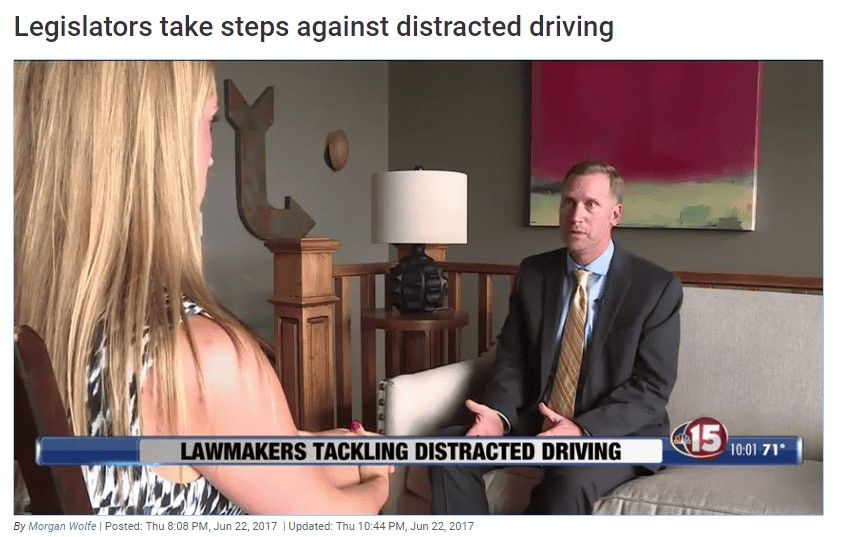
NBC 15 interviewed GCW Attorney Heath Straka about a new bi-partisan law that will work to discourage the dangers of distracted diving in the state.

Straka and the Wisconsin Association for Justice worked with Sen. Van Wanggaard, R-Racine, and Reps. Dana Wachs, D-Eau Claire, Ron Tusler, R-Harrison, and Shannon Zimmerman, R-River Falls. They say they want to update texting and driving laws to address new technologies.

“No legislation can stop people from doing certain things,” Attorney Heath Straka says,” We hope this will just deter people from doing it.”

Distracted Driving Legislation


Super Lawyers Award


Gingras, Thomsen & Wachs is happy to announce that several of their our attorneys are named as 2016 Wisconsin Super Lawyers. Super Lawyers is a rating service of outstanding lawyers from more than 70 practice areas who have attained a high-degree of peer recognition and professional achievement. The selection process is multi-phased and includes independent research, peer nominations and peer evaluations. Only five percent of Wisconsin attorneys received this honor. The survey is conducted in 48 states.

2016 Wisconsin Super Lawyers

Attorney John L. Cates has been been recognized by Wisconsin Super Lawyers every year since since 2006.

Attorney Robert J. Gingras has been been recognized by Wisconsin Super Lawyers every year since since 2006.

Attorney Michael J. Luebke has been been recognized by Wisconsin Super Lawyers every year since since 2006.

Attorney Lynn R. Laufenberg has been recognized by Wisconsin Super Lawyers every year since 2005.

Attorney Paul A. Kinne has been been recognized by Wisconsin Super Lawyers every year since since 2009 and Rising Stars in 2006 and 2007.

Attorney Heath Straka has been been recognized by Wisconsin Super Lawyers every year since since 2014 and Rising Stars in 2006-2012.

GTW has 12 attorneys located in offices in Eau Claire, Madison, Milwaukee and Waukesha, WI. GTW focuses on personal injury, insurance misconduct, professional malpractice, class action law suits, civil rights and employment law, as well as family law, supported by our personal injury attorneys in Milwaukee. For more information please contact us.

Facebook-circled Facebook-circled
Linkedin-circled Linkedin-circled
Instagram Instagram
Youtube-play Youtube-play
Rss Rss
101 Putnam St
P.O. Box 390

Eau Claire, WI 54703

8150 Excelsior
Drive

Madison, WI 53717

219 N Milwaukee St
Suite 520

Milwaukee, WI 53202

Nationally Recognized Law Firm

Super Lawyers - profiles.superlawyers.com